Parking Lot Striping Standards: Making Your Jacksonville Business Professional

Jacksonville’s bustling commercial landscape—from the Port of Jacksonville’s industrial complexes to the sprawling retail centers along Beach Boulevard—demands parking lots that handle heavy traffic while maintaining a professional appearance. With Florida’s year-round construction season and the city’s role as a major regional business hub, proper parking lot striping isn’t just about aesthetics—it’s about safety, compliance, and creating the right first impression for your customers.
At APC Asphalt Paving, we’ve been serving Jacksonville’s commercial property owners with expert striping and pavement markings that meet both federal ADA standards and local requirements. Our team understands the unique challenges of Northeast Florida’s climate, from intense summer heat that can fade inferior markings to seasonal storms that test pavement durability. Whether you’re managing a small office complex in Riverside or a major distribution center near the port, professional striping makes your property safer, more functional, and more attractive to customers and tenants.
This comprehensive guide covers everything Jacksonville business owners need to know about parking lot striping standards, from material selection and color requirements to ADA compliance and maintenance schedules.
Understanding Parking Lot Striping Materials and Durability
The foundation of professional pavement markings starts with selecting the right materials for Jacksonville’s demanding conditions. Not all striping materials perform equally under Florida’s intense UV exposure, frequent afternoon thunderstorms, and heavy traffic loads from both passenger vehicles and commercial trucks serving the region’s thriving logistics industry.
Traffic paint represents the most economical option, typically costing $0.05-0.15 per linear foot for standard 4-inch lines. This water-based or solvent-based paint works well for light-traffic areas like small office complexes or medical facilities, providing 6-12 months of service life under moderate conditions. However, Jacksonville’s intense summer sun and frequent rain can reduce this lifespan, making annual restriping necessary for maintaining professional appearance.
Thermoplastic markings offer superior durability for high-traffic commercial properties. Applied at 400-450°F, this hot-applied plastic material bonds directly to the asphalt surface and provides 3-6 years of service life even under heavy traffic conditions. While the initial cost ranges from $0.50-2.00+ per linear foot, the superior reflectivity and weather resistance make thermoplastic ideal for shopping centers, restaurants, and other businesses where parking turnover is high. The embedded glass beads maintain visibility even during Jacksonville’s frequent rain events, improving safety for customers navigating your parking areas.
For maximum durability and professional appearance, preformed tape provides 5-8 years of service life with exceptional reflectivity. Though the highest initial investment at $2.00-5.00+ per linear foot, preformed tape excels for crosswalks, arrows, and ADA-compliant accessible parking symbols. This factory-manufactured material maintains consistent appearance and performs well in Jacksonville’s humid subtropical climate, making it particularly valuable for properties where professional image is critical.
The key to material selection lies in matching the product to your specific traffic patterns and budget. A busy retail center near Town Center benefits from thermoplastic’s durability, while a professional office building might find quality traffic paint adequate with proper maintenance scheduling.
Color Standards and Professional Appearance Requirements
Professional parking lot striping follows established color standards from the Manual on Uniform Traffic Control Devices (MUTCD), ensuring consistency and safety while avoiding potential liability issues. Understanding these standards helps Jacksonville business owners make informed decisions about their property’s appearance and compliance.
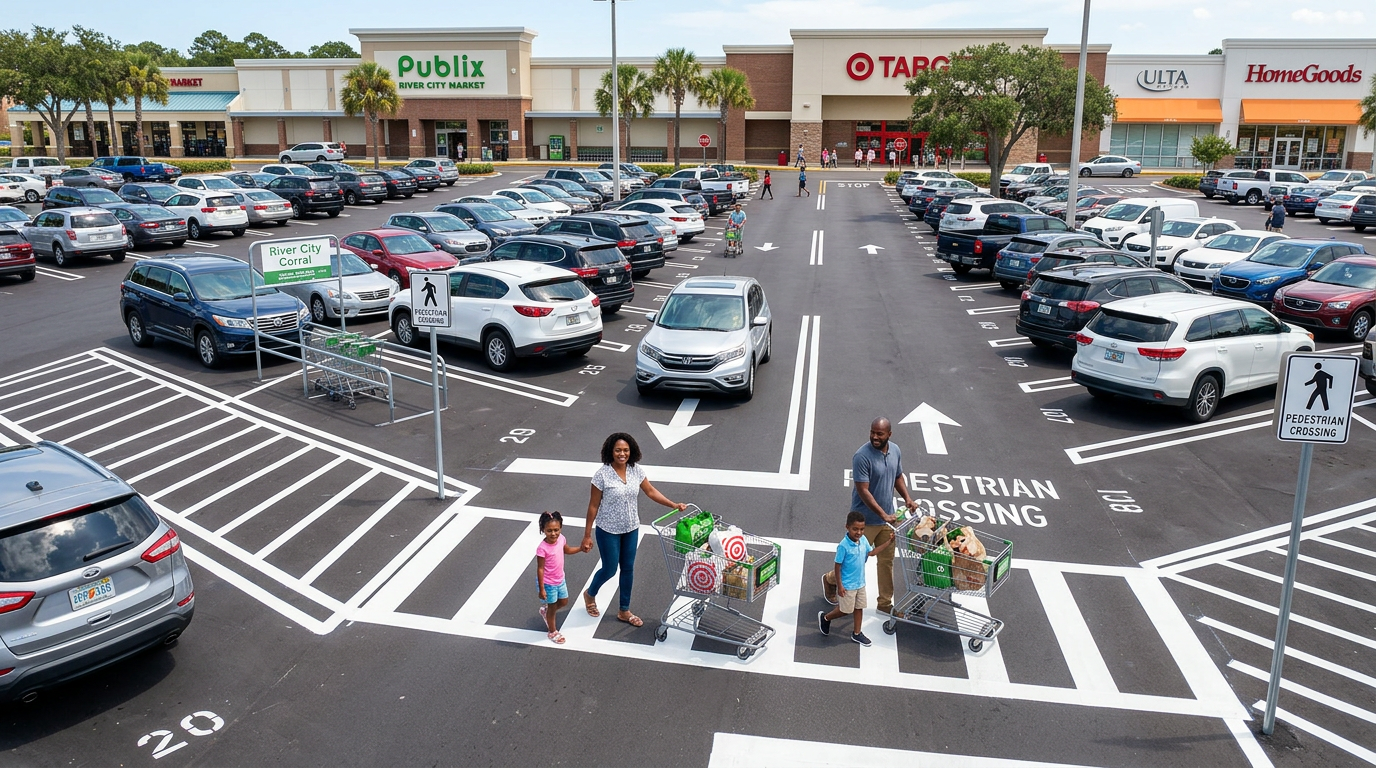
White markings form the backbone of most commercial parking lots, used for parking stall lines, crosswalks, stop bars, and directional arrows. This color separates traffic flowing in the same direction and defines individual parking spaces. In Jacksonville’s competitive business environment, crisp white striping signals professional management and attention to detail—qualities that matter whether you’re attracting retail customers to a Southside shopping plaza or professional tenants to a downtown office building.
Yellow markings indicate opposing traffic flows or barriers, primarily used for centerlines on two-way driving aisles and median edges. However, many Jacksonville parking lots use one-way traffic patterns to improve efficiency, making yellow centerlines unnecessary. The key is ensuring your striping matches your actual traffic flow—incorrect color usage confuses drivers and can increase accident risk.
Blue markings are federally mandated for ADA-compliant accessible parking spaces. The International Symbol of Accessibility must be painted in blue within each designated accessible space, and some jurisdictions require blue diagonal hatching in access aisles. This isn’t optional—missing or faded blue markings can result in ADA violations and potential lawsuits, making proper application and maintenance critical for Jacksonville business owners.
Red markings typically designate fire lanes and emergency vehicle access areas. Given Jacksonville’s strict fire code enforcement and the presence of major military installations like Naval Air Station Jacksonville requiring enhanced emergency access, proper fire lane marking is essential. Red markings must remain clearly visible and are often required to use durable materials like thermoplastic to withstand frequent inspection and heavy emergency vehicle traffic.
The professional appearance of your parking lot directly impacts customer perception and property value. Faded, inconsistent, or incorrectly colored markings suggest poor management and can drive away potential customers or tenants in Jacksonville’s competitive commercial market.
ADA Compliance and Accessible Parking Requirements
Federal ADA compliance isn’t optional for Jacksonville businesses—it’s a legal requirement that protects both property owners and ensures equal access for all customers. Understanding these requirements helps avoid costly violations while demonstrating commitment to serving the entire community.
Accessible parking space requirements are based on total parking capacity. Properties with 1-25 spaces need one accessible space, while larger lots require additional spaces following ADA guidelines—approximately one accessible space per 25 total spaces. For Jacksonville’s many shopping centers and office complexes, this typically means multiple accessible spaces strategically located for maximum convenience.
Van-accessible spaces must comprise at least one in every six accessible spaces, featuring wider 8-foot access aisles to accommodate wheelchair lifts and ramps. These spaces serve Jacksonville’s significant population of veterans and military families from nearby Naval Station Mayport and NAS Jacksonville, many of whom rely on accessible transportation. Van-accessible spaces require both pavement markings and vertical signage clearly identifying their special designation.
Location requirements mandate that accessible spaces be positioned on the shortest accessible route to building entrances, with maximum 2% slope in all directions. This is particularly important in Jacksonville, where older commercial properties may have challenging topography or drainage requirements that complicate ADA compliance. Proper design during initial construction or renovation prevents expensive retrofitting later.
Access aisles adjacent to accessible parking spaces must remain completely clear of vehicles, shopping carts, landscaping, or other obstructions. These 5-foot (standard) or 8-foot (van-accessible) zones provide space for wheelchair users to exit vehicles and deploy mobility equipment. Diagonal hatching clearly marks these areas, and property managers must ensure they stay clear through proper maintenance and customer education.
Signage requirements mandate vertical signs at 60 inches minimum height for each accessible space, displaying the International Symbol of Accessibility. Van-accessible spaces need additional “Van Accessible” designation. Pavement markings alone don’t satisfy ADA requirements—proper signage is mandatory and must remain visible and unobstructed.
Jacksonville business owners face potential lawsuits and federal fines for ADA violations, making compliance a critical business protection issue. Professional striping contractors familiar with current ADA standards help ensure your property meets all requirements while serving customers with disabilities effectively.
Proper Layout Design and Traffic Flow Optimization
Effective parking lot layout maximizes space utilization while ensuring safe, efficient traffic flow—critical factors for Jacksonville businesses competing for customers in busy commercial corridors like Phillips Highway, Atlantic Boulevard, or Baymeadows Road.
Standard parking stall dimensions of 9 feet wide by 18 feet long provide adequate space for vehicle doors and passenger access while accommodating most cars, SUVs, and light trucks common in Jacksonville’s vehicle mix. Compact spaces (7.5-8 feet wide) can be used for up to 30% of total spaces, allowing higher parking density for businesses where space is premium. However, oversized vehicles are common in Jacksonville, making standard 9-foot stalls the safer choice for customer satisfaction.
Aisle width requirements depend on parking angle and traffic flow patterns. Perpendicular (90-degree) parking requires 24-26 foot aisles for safe maneuvering, while angled parking allows narrower aisles—18-20 feet for 60-degree angles and 13-15 feet for 45-degree angles. Jacksonville’s many strip shopping centers often benefit from angled parking, which speeds customer turnover and reduces backing accidents.
Traffic flow patterns should minimize conflicts and confusion, particularly important for businesses serving Jacksonville’s diverse population including tourists, military personnel, and international visitors who may be unfamiliar with local layouts. One-way aisles with directional arrows improve efficiency and safety, while clear sight lines and adequate turning radii accommodate larger vehicles common in Florida.
Fire lane requirements mandate 20-26 foot wide emergency access routes marked with red paint or striping. Jacksonville’s fire marshal strictly enforces these requirements, and violations can delay occupancy permits or result in fines. Fire lanes must provide access to all building entrances and accommodate fire truck turning radii, requiring coordination between paving and striping contractors during design.
Professional layout design considers peak usage patterns, customer demographics, and local traffic conditions. A restaurant near Jacksonville University needs different traffic flow than a medical office serving elderly patients or a retail center handling delivery trucks from the nearby port operations. Proper design improves customer experience while reducing liability exposure.
Application Timing and Surface Preparation Standards
Successful parking lot striping requires proper timing and surface preparation—factors that significantly impact marking durability and appearance in Jacksonville’s challenging climate conditions.
New asphalt curing requirements mandate waiting minimum 30 days before applying pavement markings, allowing volatile oils to evaporate and the surface to properly harden. Jacksonville’s hot, humid climate can accelerate this process, but rushing application results in poor adhesion and premature failure. The water beading test helps determine readiness—when water no longer beads on the surface, the asphalt is approaching proper cure.
Surface preparation is critical for marking adhesion and longevity. The pavement must be completely clean, dry, and free of oil, dirt, or debris. Jacksonville’s frequent afternoon thunderstorms can complicate scheduling, requiring careful weather monitoring to ensure dry conditions during application and adequate cure time before rain. Professional contractors use proper cleaning equipment and techniques to prepare surfaces for optimal marking performance.
Weather conditions during application directly affect quality and durability. Pavement temperature should be at least 50°F and rising, with no rain expected for 2-4 hours after application. Jacksonville’s year-round construction season provides excellent striping weather most of the year, but summer afternoon storms require careful timing. Morning applications often work best, allowing cure time before typical afternoon weather patterns develop over the St. Johns River area.
Hurricane season considerations from June through November require special planning for Jacksonville businesses. While the city’s inland location provides some protection from direct hurricane impacts, tropical storms and heavy rain events can damage fresh striping. Scheduling major striping projects for spring or fall often provides the most stable weather conditions for optimal results.
At APC Asphalt Paving, we coordinate striping timing with paving schedules and weather conditions to deliver professional results that last. Our experience with Jacksonville’s climate patterns helps ensure your markings cure properly and maintain appearance through Florida’s demanding weather conditions.
Maintaining Professional Standards Year-Round
Professional parking lot appearance requires ongoing maintenance and periodic restriping to maintain safety, compliance, and curb appeal in Jacksonville’s competitive business environment.
Regular inspection identifies fading, wear, or damage before markings become illegible or non-compliant. Jacksonville’s intense UV exposure and frequent storms accelerate marking deterioration, making proactive maintenance more cost-effective than emergency restriping. Business owners should monitor high-traffic areas, accessible parking symbols, and fire lane markings for signs of wear.
Cleaning and minor touch-ups extend marking life and maintain professional appearance between major restriping cycles. Pressure washing removes dirt and stains that make markings appear faded, while spot touch-ups address small areas of wear or damage. This preventive approach keeps properties looking professional while maximizing the investment in quality striping materials.
Seasonal maintenance scheduling works best when aligned with Jacksonville’s weather patterns. Spring cleaning and touch-ups prepare for the busy summer season, while fall maintenance addresses any hurricane season damage and prepares for the cooler months when many businesses see increased activity from seasonal residents and tourists.
Professional restriping intervals depend on material choice and traffic levels. High-traffic retail centers may need annual attention, while office complexes might maintain professional appearance for 2-3 years with quality materials. The key is monitoring appearance and addressing issues before they impact customer perception or compliance requirements.
APC Asphalt Paving serves Jacksonville and surrounding areas including Orange Park, St. Augustine, and throughout Northeast Florida with comprehensive parking lot striping and maintenance services. Owner John Wells and our experienced team understand local requirements, climate challenges, and business needs, delivering professional results that enhance your property’s appearance and functionality.
Our striping services include complete layout design, ADA compliance verification, material selection guidance, and ongoing maintenance programs tailored to your business needs. We use professional-grade equipment and quality materials designed to withstand Jacksonville’s demanding climate while maintaining the crisp, professional appearance your customers expect.
Whether you need initial striping for a new parking lot, compliance updates for ADA requirements, or maintenance for existing markings, we provide expert service backed by years of experience in Jacksonville’s commercial market. Our comprehensive approach ensures your parking lot striping meets all safety standards while enhancing your property’s curb appeal and professional image.
Ready to improve your Jacksonville business property with professional parking lot striping? Contact APC Asphalt Paving today for a free estimate and discover how proper striping standards can enhance your property’s safety, compliance, and customer appeal.
Call us at (𝟴𝟬𝟬) 𝟳𝟳𝟵-𝟬𝟳𝟲𝟳 or visit our website at apcasphaltpaving.com to schedule your consultation and ensure your Jacksonville business maintains the professional standards your customers expect.
